Rss Feed
Showing posts with label law. Show all posts

Homeschooling: German Family Gets Political Asylum in U.S.

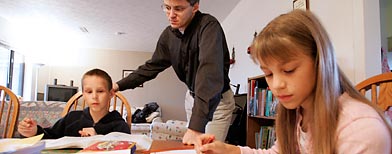
READ Yahoo! News: "The Romeikes are not your typical asylum seekers. They did not come to the U.S. to flee war or despotism in their native land. No, these music teachers left Germany because they didn't like what their children were learning in public school - and because homeschooling is illegal there. (See pictures of a Tennessee family homeschooling its children.)

'It's our fundamental right to decide how we want to teach our children,' says Uwe Romeike, an Evangelical Christian and a concert pianist who sold his treasured Steinway to help pay for the move.

Romeike decided to uproot his family in 2008 after he and his wife had accrued about $10,000 in fines for homeschooling their three oldest children and police had turned up at their doorstep and escorted them to school. 'My kids were crying, but nobody seemed to care,' Romeike says of the incident. (See pictures of a diverse group of American teens.)

So why did he seek asylum in the U.S. rather than relocate to nearby Austria or another European country that allows homeschooling? Romeike's wife Hannelore tells TIME the family was contacted by the Virginia-based Home School Legal Defense Association (HSLDA), which suggested they go to the U.S. and settle in Morristown, Tenn. The nonprofit organization, which defends the rights of the U.S. homeschooling community - with its estimated 2 million children, or about 4% of the total school-age population - is expanding its overseas outreach. And on Jan. 26, the HSLDA helped the Romeikes become the first people granted asylum in the U.S. because they were persecuted for homeschooling. (See pictures of East Germany making light of its past.)

The ruling is tricky politically for Washington and its allies in Europe, where several countries - including Spain and the Netherlands - allow homeschooling only under exceptional circumstances, such as when a child is extremely ill. That helps explain why in late February, U.S. Immigration and Customs Enforcement formally appealed the Romeike ruling, which was issued by an immigration judge in Memphis, Tenn. His unprecedented decision has raised concerns that the already heavily backlogged immigration courts will be flooded with asylum petitions from homeschoolers in countries typically regarded as having nonrepressive governments. (Comment on this story.)"

How to Meet Educational Standards for Homeschooling

How to Meet Educational Standards for Homeschooling | eHow.com: "Thanks to the work of many organizations and individuals, homeschooling is legal in all 50 states. Each state sets its own regulations, which range from very lax to somewhat troublesome. It is important to meet your state's mimimum requirements, and, fortunately, excellent resources are available to help you navigate the law."

California homeschooling being given 2nd chance

California homeschooling being given 2nd chance: "A California court order that essentially banned homeschooling in the state has been vacated, and the judges who issued the ruling will hear further arguments on the status of parents who want to teach their own children."

Whose kids are they?

Whose kids are they?: "Recently the Second District Court of Appeal ruled that parents have no constitutional right to educate their children at home without state certification. In his written opinion, Justice H. Walter Croskey cited a long series of rulings indicating that the parental right to educate their own children is not absolute under American constitutional law. But the court’s ruling raises the serious question of whether it is good public policy for the State of California to insist that all children be educated by people who have a teaching credential. The most lucid arguments favor the position that homeschooling should be at least a permissible option, possibly even encouraged by the state."

Law News: No Constitutional Right to Homeschool

Attorney Timothy Herr, Esq. discusses In re Rachel L., decided by the California Court of Appeal, on February 28, 2008, in a short web video. In summary: Parents do not have a constitutional right to home school their children. - Copyright 2008 http://www.dailycasereort.com/

NOTE from Ryan: Mr. Herr does a VERY good job explanation the recent California Court of Appeal ruling last month that seems to restrict homeschooling in California.

Criminalizing Home Schoolers - Yahoo! News

Criminalizing Home Schoolers - Yahoo! News: "Parents of the approximately 200,000 home-schooled children in California are reeling from the possibility that they may have to shutter their classrooms - and go back to school themselves - if they want to continue teaching their own kids. On Feb. 28, Judge H. Walter Croskey of the Second District Court of Appeals in Los Angeles ruled that children ages six to 18 may be taught only by credentialed teachers in public or private schools - or at home by Mom and Dad, but only if they have a teaching degree. Citing state law that goes back to the early 1950s, Croskey declared that 'California courts have held that under provisions in the Education Code, parents do not have a constitutional right to home school their children.' Furthermore, the judge wrote, if instructors teach without credentials they will be subject to criminal action."

Home-schoolers reel from California court blow - Yahoo! News

Home-schoolers reel from California court blow - Yahoo! News: "Oakland, Calif. - A court ruling that California parents 'do not have a constitutional right' to home-school their children has touched off anger and bewilderment throughout America's home-schooling community and prompted a denunciation from Gov. Arnold Schwarzenegger.

For a movement that has gained greater accommodation in recent years, a state appellate court decision last month is a setback that, if not overturned on appeal, could force some 166,000 home-schooled students in California to enroll in conventional schools. It may also prod California and other states with vague or nonexistent laws on home schooling to be more specific about what is allowed and what is required of home-schoolers."

BREAKING NEWS: Homeschoolers' setback in appeals court ruling

Bob Egelko,Jill Tucker, Chronicle Staff Writers
Friday, March 7, 2008

(03-06) 14:26 PST LOS ANGELES --

A California appeals court ruling clamping down on homeschooling by parents without teaching credentials sent shock waves across the state this week, leaving an estimated 166,000 children as possible truants and their parents at risk of prosecution.

The homeschooling movement never saw the case coming.

"At first, there was a sense of, 'No way,' " said homeschool parent Loren Mavromati, a resident of Redondo Beach (Los Angeles County) who is active with a homeschool association. "Then there was a little bit of fear. I think it has moved now into indignation."

The ruling arose from a child welfare dispute between the Los Angeles County Department of Children and Family Services and Philip and Mary Long of Lynwood, who have been homeschooling their eight children. Mary Long is their teacher, but holds no teaching credential.

The parents said they also enrolled their children in Sunland Christian School, a private religious academy in Sylmar (Los Angeles County), which considers the Long children part of its independent study program and visits the home about four times a year.

The Second District Court of Appeal ruled that California law requires parents to send their children to full-time public or private schools or have them taught by credentialed tutors at home.

Some homeschoolers are affiliated with private or charter schools, like the Longs, but others fly under the radar completely. Many homeschooling families avoid truancy laws by registering with the state as a private school and then enroll only their own children.

Yet the appeals court said state law has been clear since at least 1953, when another appellate court rejected a challenge by homeschooling parents to California's compulsory education statutes. Those statutes require children ages 6 to 18 to attend a full-time day school, either public or private, or to be instructed by a tutor who holds a state credential for the child's grade level.

"California courts have held that ... parents do not have a constitutional right to homeschool their children," Justice H. Walter Croskey said in the 3-0 ruling issued on Feb. 28. "Parents have a legal duty to see to their children's schooling under the provisions of these laws."

Parents can be criminally prosecuted for failing to comply, Croskey said.

"A primary purpose of the educational system is to train school children in good citizenship, patriotism and loyalty to the state and the nation as a means of protecting the public welfare," the judge wrote, quoting from a 1961 case on a similar issue.

Union pleased with ruling

The ruling was applauded by a director for the state's largest teachers union.

"We're happy," said Lloyd Porter, who is on the California Teachers Association board of directors. "We always think students should be taught by credentialed teachers, no matter what the setting."

A spokesman for the state Department of Education said the agency is reviewing the decision to determine its impact on current policies and procedures. State Superintendent of Public Instruction Jack O'Connell issued a statement saying he supports "parental choice when it comes to homeschooling."

Brad Dacus, president of the Pacific Justice Institute, which agreed earlier this week to represent Sunland Christian School and legally advise the Long family on a likely appeal to the state Supreme Court, said the appellate court ruling has set a precedent that can now be used to go after homeschoolers. "With this case law, anyone in California who is homeschooling without a teaching credential is subject to prosecution for truancy violation, which could require community service, heavy fines and possibly removal of their children under allegations of educational neglect," Dacus said.

Parents say they choose homeschooling for a variety of reasons, from religious beliefs to disillusionment with the local public schools.

Homeschooling parent Debbie Schwarzer of Los Altos said she's ready for a fight.
Schwarzer runs Oak Hill Academy out of her Santa Clara County home. It is a state-registered private school with two students, she said, noting they are her own children, ages 10 and 12. She does not have a teaching credential, but she does have a law degree.

"I'm kind of hoping some truancy officer shows up on my doorstep," she said. "I'm ready. I have damn good arguments."

She opted to teach her children at home to better meet their needs.

The ruling, Schwarzer said, "stinks."

Began as child welfare case

The Long family legal battle didn't start out as a test case on the validity of homeschooling. It was a child welfare case.

A juvenile court judge looking into one child's complaint of mistreatment by Philip Long found that the children were being poorly educated but refused to order two of the children, ages 7 and 9, to be enrolled in a full-time school. He said parents in California have a right to educate their children at home.

The appeals court told the juvenile court judge to require the parents to comply with the law by enrolling their children in a school, but excluded the Sunland Christian School from enrolling the children because that institution "was willing to participate in the deprivation of the children's right to a legal education."

The decision could also affect other kinds of homeschooled children, including those enrolled in independent study or distance learning through public charter schools - a setup similar to the one the Longs have, Dacus said.

Charter school advocates disagreed, saying Thursday that charter schools are public and are required to employ only credentialed teachers to supervise students - whether in class or through independent study.

Ruling will apply statewide

Michael Smith, president of the Home School Legal Defense Association, said the ruling would effectively ban homeschooling in the state.

"California is now on the path to being the only state to deny the vast majority of homeschooling parents their fundamental right to teach their own children at home," he said in a statement.

But Leslie Heimov, executive director of the Children's Law Center of Los Angeles, which represented the Longs' two children in the case, said the ruling did not change the law.

"They just affirmed that the current California law, which has been unchanged since the last time it was ruled on in the 1950s, is that children have to be educated in a public school, an accredited private school, or with an accredited tutor," she said. "If they want to send them to a private Christian school, they can, but they have to actually go to the school and be taught by teachers."

Heimov said her organization's chief concern was not the quality of the children's education, but their "being in a place daily where they would be observed by people who had a duty to ensure their ongoing safety."

Online resources

The ruling: To view the ruling by the Second District Court of Appeal, go to links.sfgate.com/ZCQR.

E-mail the writers at begelko@sfchronicle.com and jtucker@sfchronicle.com.
http://sfgate.com/cgi-bin/article.cgi?f=/c/a/2008/03/07/MNJDVF0F1.DTL

This article appeared on page A - 1 of the San Francisco Chronicle

This Just In... How Many Homeschool?

voiceofsandiego.org: This Just In... How Many Homeschool?: "When writing about charter schools that cater to homeschooled students, I got curious about just how many San Diegans homeschool without the help of such programs.

Tracking homeschooling is tough, because parents who homeschool can do so through a variety of venues -- independent study programs sponsored by school districts, the charter schools I wrote about, and starting up a program at home, from scratch."

State schools ease way for homeschooled

The Associated Press

Colleges revamp application process for nontraditionally schooled students

LOS ANGELES - David Sample wanted to attend the University of California, Riverside, but thought it was a lost cause because he had been homeschooled.

The UC system is known for being tough on nontraditionally schooled applicants. For them, the best tickets to UC have been transferring in after taking community college classes or posting near-perfect scores on college entrance exams.

"For homeschoolers, it was basically a shut door for us because of the restrictions," Sample said.

Last fall, however, Riverside joined a growing number of colleges around the country that are revamping application policies to accommodate homeschooled students.

The change came just in time for the 18-year-old Sample to apply and get accepted with a substantial scholarship.

Under Riverside's new policy, homeschoolers can apply by submitting a lengthy portfolio detailing their studies and other educational experiences.

Sample's package showed he had studied chemistry, U.S. history and geometry, rewired a house and helped rebuild a medical clinic in Nicaragua.

Over 1 million homeschooledThe U.S. Department of Education reports that 1.1 million, or 2.2 percent of all students in the nation, are homeschooled.

Some private colleges have eagerly recruited those students for years and tailored application processes to include them. Homeschoolers still face challenges when applying to many public universities, but their chances of being considered are improving.

In 2000, 52 percent of all colleges in the country had a formal evaluation policy for applications from homeschoolers, said David Hawkins, director of public policy for the National Association for College Admission Counseling.

Four years later, the number jumped to 83 percent. During that time, 45 percent of colleges reported receiving more applications from homeschoolers, he said.

Major schools that now post application procedures for homeschoolers on their Web sites include Michigan State University, Oregon State University and the University of Texas.

The Massachusetts Institute of Technology is also willing to consider homeschoolers. The highly regarded school does not require a high school diploma. As part of its admissions process, it considers scores from college entrance exams and asks applicants to submit a 500-word essay, detail five extracurricular activities and offer two teacher evaluations.

"We evaluate every student based on who they are," said Merilee Jones, dean of admissions at MIT.

UC Riverside is actively recruiting homeschoolers, said Merlyn Campos, interim director of undergraduate admissions.

"There are a lot of students out there that are very prepared for a college level education," she said. "They are kind of being forced into going into a community college."

Frank Vahid, a UC Riverside computer science professor, was among those who lobbied for the change, contending the school could gain a competitive advantage because homeschoolers have a lot to offer.

Vahid's own children are taught at home. His 15-year-old son also takes community college classes and will likely try to transfer into a public university.

The homeschooling movement has its roots in religion, but families pull their children out of traditional schools for a variety of reasons. When many of those students reached college age in the 1990s, colleges began considering their qualifications and potential more closely.

"Colleges are far more familiar with the backgrounds of homeschoolers and their needs," said Ian Slatter, director of media relations for the Home School Legal Defense Association. "We have had fewer and fewer problems."

Harrison Hartley has been homeschooled in Burbank since kindergarten. Now 13, he will start community college classes this year and hopes to transfer to a university as a junior before he turns 18.

"I just want him to start out with taking a couple of fun classes," said his mother, Beverly Hartley. "Then we'll throw him into things that are more serious."

'You are already used to teaching yourself'Sample lives in Redlands with his parents and three younger siblings, who are also homeschooled. He got acceptance letters from colleges in Illinois and Texas but wanted to attend Riverside, the local university.

Now a freshman, he is adjusting well to college classes and shrugs when his peers complain about the way a professor teaches.

"You are already used to teaching yourself," he said about homeschooling. "Forget the teacher, forget the class, I am just going to read the book and figure it out myself."

His mother, Ellen Sample, is grateful that universities are more willing to consider the work of homeschoolers and the family members who teach them.

"We knock ourselves out, we work very, very hard," she said. "There are lot of places that receive us without question. Why go someplace that would require more of our kids?"